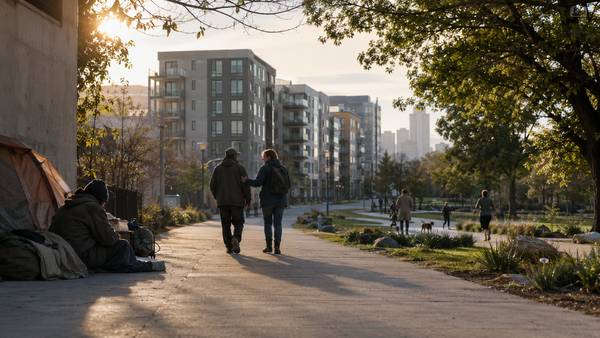
Homeless: The Public Commons Under Stress


Why homelessness becomes a civic conflict
Voice & Vision | Homelessness and the Public Commons, Part 4 | Public space impacts
Most people don’t meet homelessness through empathy. They meet it through disruption.
If you missed it, here is part 3: The Accelerants.
They meet it when the park stops feeling like a park. When the sidewalk stops feeling neutral. When the library becomes a crisis center. When the transit stop becomes a place you don’t want to stand alone. When the business corridor starts to smell like urine and the foot traffic changes.
That’s not a moral failure. That’s a civic signal. It’s the signal that the commons is under stress.
The commons is the shared fabric of a city. Sidewalks, parks, buses, train stations, plazas, libraries. When the commons degrades, trust degrades, and when trust degrades, people start demanding simple answers with sharp edges.
This is where the sentence appears again. “I want to help, but not like this.”
That sentence should not be dismissed. It should be examined. Because it’s often the hinge between a city that can sustain long-term solutions and a city that swings into backlash politics.
Here’s what residents often mean. They mean: the burden is concentrated and nobody seems accountable. They mean: rules are being suspended in public space but only in certain neighborhoods. They mean: my kid shouldn’t be stepping over needles. They mean: I’m being told to accept permanent disorder as the price of compassion, and I don’t believe that is compassion at all.
If leaders ignore those concerns, the political outcome is predictable. People stop supporting housing projects, shelters, harm reduction, and treatment expansions because they associate all of it with visible disorder. They demand enforcement without nuance. They vote for whoever promises to “clean it up,” even if the cleaning is just relocation.
But the opposite failure is also predictable. If leaders treat public-space restoration as the whole solution, they default to churn. Sweeps, displacement, confiscation, pressure, and the tents reappear somewhere else. Outreach relationships get broken. People lose documents and medications. The street becomes more chaotic. The public sees motion but not progress. The unhoused experience trauma without exits.
Neither failure restores the commons. One produces surrender. The other produces theater.
So what does a workable approach look like?
It starts with acknowledging that shared space must remain usable. A society cannot function if parks become permanent camps and sidewalks become obstacle courses. That’s not anti-homeless. It’s pro-civic life. The commons is one of the few places where a community encounters itself. When it collapses, the city becomes a set of isolated private bubbles connected by fear.
But restoring the commons requires legitimacy. Legitimacy means boundaries paired with real alternatives.
If a city wants rules in public space, it must offer places people can go. Safe shelter. Stabilization sites. A pathway that doesn’t require perfection. Options that people will actually accept because they’re safer than the street. Without alternatives, enforcement becomes punishment, and punishment without exits doesn’t reduce homelessness. It just moves it around and deepens mistrust.
This is also where geography matters. When services cluster, tolerance clusters, and enforcement is inconsistent, the crisis clusters. A few neighborhoods become the pressure valve for a whole region. The residents in those neighborhoods don’t just feel inconvenience. They feel sacrificed. They feel used to absorb a failure that isn’t theirs alone.
If a community wants the commons back, it has to distribute responsibility regionally and manage the commons locally, with clear standards and consistent follow-through.
There’s a practical way to talk about this that avoids moral shouting. Public space needs standards. It needs sanitation, safety, and predictability. People living outside need pathways that are real. Outreach has to connect to capacity, not to lists. And the public needs to see measurable improvement over time, not perfection, but direction.
Because here’s what people will tolerate, even generously, if they believe it’s temporary and managed. What they won’t tolerate is open-ended disorder with no plan and no accountability.
The public commons is where homelessness becomes political because it’s where the costs become daily. Any serious homelessness strategy has to treat the commons as part of the solution, not as a side effect.
Part 5 will take us into the machinery behind the scenes, why cities struggle to coordinate and why “simple fixes” fail even when the intent is real.