Homeless: The Accelerants


Why some people get stuck outside longer
Voice & Vision | Homelessness and the Public Commons, Part 3 | Vulnerability
There’s a certain kind of homelessness conversation that sounds sympathetic but is actually a dodge. It goes like this: homelessness is a housing problem, full stop.
That sentence contains truth. It’s also a way to avoid harder realities. Because even if housing is the main driver at scale, vulnerability is the reason some people get stuck outside longer, deteriorate faster, and become the most visible form of public crisis.
Part 2, The Housing Pressure Cooker was about why people fall in. Part 3 is about why climbing out is not a simple reversal.
Here’s a scene.
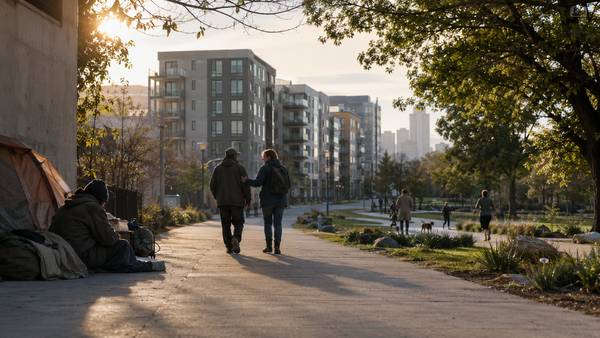
It’s late afternoon and an outreach worker is talking to someone sitting on a curb. The outreach worker is calm, patient, doing what they can. They offer options. A shelter bed, a referral, a ride to intake. The person nods, then drifts, then forgets what was said. They’re not being rude. Their mind is not holding the thread. They’re exhausted, suspicious, maybe high, maybe hearing voices, maybe so stressed that normal thinking doesn’t work. The outreach worker isn’t dealing with a policy problem. They’re dealing with a nervous system that’s been living in emergency mode for months, possibly longer.
That’s vulnerability.
Mental illness, addiction, trauma, disability, domestic violence, brain injury, aging, chronic illness, those are not moral labels. They’re constraints. They affect follow-through, trust, impulse control, memory, and the ability to tolerate structured environments.
A person with strong supports can sometimes recover from a housing shock quickly. A person with untreated psychosis, severe depression, cognitive decline, or active addiction is unlikely to complete the steps required to stabilize, even if help exists. That doesn’t mean help is pointless. It means the kind of help matters. Now add the street. Homelessness is not a neutral condition. It is an accelerant.
Sleep deprivation alone can dismantle a person. Add exposure, theft, assault risk, infection, malnutrition, constant stress, and you get rapid decline. This is why the longer someone is unsheltered, the harder it becomes to “just get back on your feet.” The feet are not just tired. They’re damaged. The mind is frayed. The person becomes less able to do the very things the system demands.
This is where the public often forms its harshest judgments. People see the most disorganized, most visible crisis behavior and assume that is the whole population. They see public drug use and assume everyone is choosing it. They see someone yelling at the air and assume nothing can be done. Fear grows, compassion shrinks, and politics shifts toward removal.
The danger in that reaction is that it treats vulnerability as a reason to abandon people, or as a reason to punish them. Neither works.
Vulnerability requires a ladder of care, not a single door with a single rule set.
Some people need immediate stabilization more than they need a lecture. They need a place where sleep is possible. They need consistent access to medication. They need a calm environment where their nervous system can settle. They need harm reduction in the short term, and treatment pathways that are reachable in the real world, not reachable only by someone who has a calendar, a phone, a stable mind, and a week of patience.
This is also where the toughest policy debates live. Voluntary versus involuntary treatment. Rights versus safety. Compassion versus control. Coercion can be abused. History proves it. Any system that allows involuntary holds needs strict safeguards and oversight.
But there is another form of harm people refuse to name. Abandonment. Leaving someone to die slowly in public is not a civil-rights achievement. It’s neglect.
The mature position sits between slogans. It says build voluntary pathways that work for most people, expand crisis stabilization capacity, and create narrow, lawful, tightly supervised processes for involuntary stabilization in extreme cases where someone cannot meet basic survival needs and is at clear risk of death or severe harm.
The goal is not punishment. The goal is care that can actually hold a person when their capacity is gone.
This vulnerability layer also explains why help sometimes fails even when it’s offered. If the only help is a chaotic shelter, some people will avoid it. If the only pathway requires sobriety first, some people will never enter. If the only housing option is independent living with minimal support, some people will not be able to keep it. When programs fail, the street becomes the default again, and the public concludes nothing works.
But something does work. What works is matching interventions to reality.
Part 3 is not about excusing harmful behavior. It’s about understanding why the same approach won’t work for everyone. If you want fewer people stuck outside, we have to build a system that can stabilize, treat, and support, not just a system that can offer a flyer and hope for the best.
Next week in part 4 The Public Commons Under Stress we talk about why this becomes a civic fight. When vulnerability spills into shared space, sympathy collides with fear, and governance gets tested. The public commons becomes the stage where every unresolved layer shows itself.