Homeless: Rights, Equity, and the Limits of Force

What we can do, what we must not do, and what we must build
Voice & Vision | Homelessness and the Public Commons, Part 7 | Legitimacy
Homeless: Pipeline Problems, Part 6.
This is the part where people stop pretending it’s simple.
When someone is living in a tent near a playground, the public wants action. When someone is clearly in mental health crisis, screaming at the air, the public wants safety. When someone is using drugs in public, the public wants order. When someone is sleeping in a doorway in winter, the public wants a humane response. The problem is, those wants collide.
The rights and legitimacy layer is about boundaries. What is lawful? What is humane? What is enforceable? But what happens when a society tries to solve homelessness with force, or tries to avoid force by surrendering the commons?
History matters here. Societies have used coercion against poverty before, and it often turned into abuse. That is why due process exists. That is why we are cautious about involuntary holds. That is why we recoil when homelessness gets treated as a crime.
But another form of harm also exists, and it often hides behind good intentions. Abandonment. Leaving people to live and die in public is not a civil-rights triumph. It’s neglect. It’s a society washing its hands while suffering unfolds in plain sight.
The legitimacy question is this: can a community maintain usable public space while treating the unhoused as human beings, and while protecting the rights that prevent abuse?
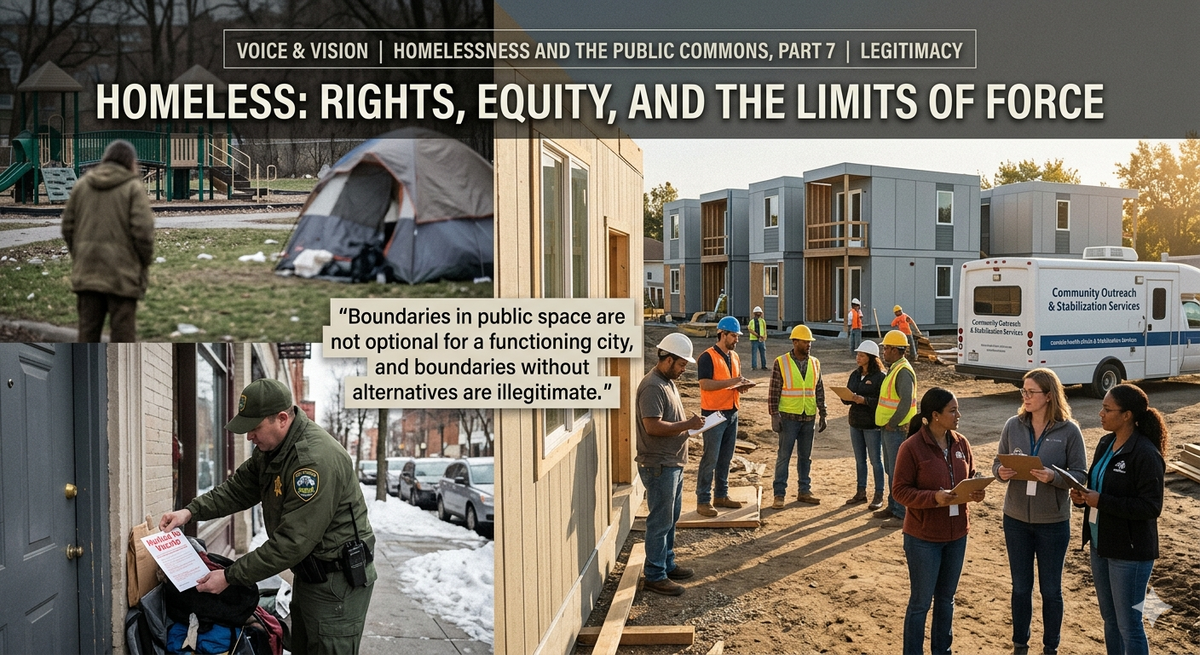
A workable answer requires a truth that neither extreme wants to admit. Boundaries in public space are not optional for a functioning city, and boundaries without alternatives are illegitimate.
If a city enforces camping bans and loitering laws without offering real shelter, stabilization, or housing pathways, it is punishing people for being poor. It is creating churn, citations, arrests, and deeper instability, then acting surprised when homelessness persists. If a city refuses enforcement entirely in the name of rights, it is surrendering the commons. That surrender concentrates harm in specific neighborhoods and produces backlash. Backlash rarely produces nuanced compassion. Backlash produces sharper tools and fewer rights.
This is the paradox. If you want rights protected long-term, you have to build systems that make order possible without cruelty. Otherwise politics will do what politics does when people feel unsafe and unheard.
Equity matters here too. Homelessness is not evenly distributed, and enforcement is not evenly applied. Visibility tends to track powerlessness. The people most likely to be moved, cited, arrested, or pushed out of sight are often those with the fewest resources, the fewest advocates, the least ability to comply. That is how enforcement can become a pipeline into deeper homelessness.
At the same time, lack of enforcement is not neutral. Encampments can become unsafe environments where the most vulnerable are preyed upon. Public drug markets expand. Fires happen. Overdoses happen. Women and older people are often at higher risk in unmanaged outdoor settings. Surrender can be its own form of harm.
So what does legitimate policy look like?
It looks like building real alternatives first, then enforcing clear standards with consistency and restraint. Safe shelter options. Stabilization options. Treatment capacity. Supportive housing. Prevention. If those pathways exist, enforcement becomes a boundary, not a weapon.
It also looks like due process and oversight. Any coercive tool must be narrow, carefully supervised, and tied to care, not punishment. Any enforcement of public space must be paired with documentation of alternatives offered and outcomes achieved.
This layer is where a society proves whether it is serious about compassion. Compassion is not only empathy. Compassion is building. It is creating pathways that reduce death and disorder at the same time. It is refusing to pretend that the only moral choices are softness or cruelty.
This installment is uncomfortable because it requires moral adulthood. You can acknowledge rights and still demand a functional commons. You can demand order and still insist on humane alternatives. Those aren’t contradictions. They’re the only way a system holds.
Part 8 Homeless: The Only Way this Works, is the synthesis, the final piece. It’s where we stop fighting about which layer matters and start building a response that matches the whole system.
Last week's article: The Unpracticed Mind: Are We Getting Dumber?