The Unpracticed Mind: Are We Getting Dumber?

Why declining test scores do not tell the whole story
Voice & Vision | The Unpracticed Mind, Part 1 | Cognitive decline
It is a rude question, which is one reason serious people avoid asking it directly.
Are Americans getting dumber?
The question sounds arrogant. It sounds like something said by someone who has already decided the answer and is only looking for evidence to insult everyone else. It can also become a lazy generational complaint, the familiar claim that people used to be sharper, tougher, better read, more serious, more capable, and more grounded.
But the fact that a question can be asked badly does not mean it should not be asked at all.
Something does feel different. Public arguments seem thinner. Certainty arrives faster. People seem more willing to dismiss evidence that would have embarrassed them in another setting. Many can gather information quickly, but fewer seem able to sort it carefully. A person can know the latest controversy, repeat five talking points, cite a favorite source, and still struggle to follow a complex argument without turning it into a team sport.
That does not prove Americans are less intelligent.
It does suggest that something in our thinking environment has changed.
The first mistake is treating intelligence as one simple thing. It is not. What we casually call intelligence includes many overlapping abilities: vocabulary, memory, verbal reasoning, abstract pattern recognition, numerical skill, spatial awareness, attention, problem solving, judgment, and the ability to revise a belief when evidence changes.
Some of those skills can rise while others fall. Some depend heavily on practice. Some are shaped by schooling, culture, work, nutrition, technology, and what daily life repeatedly asks the mind to do.
That is why the word “dumber” is too blunt for the problem.
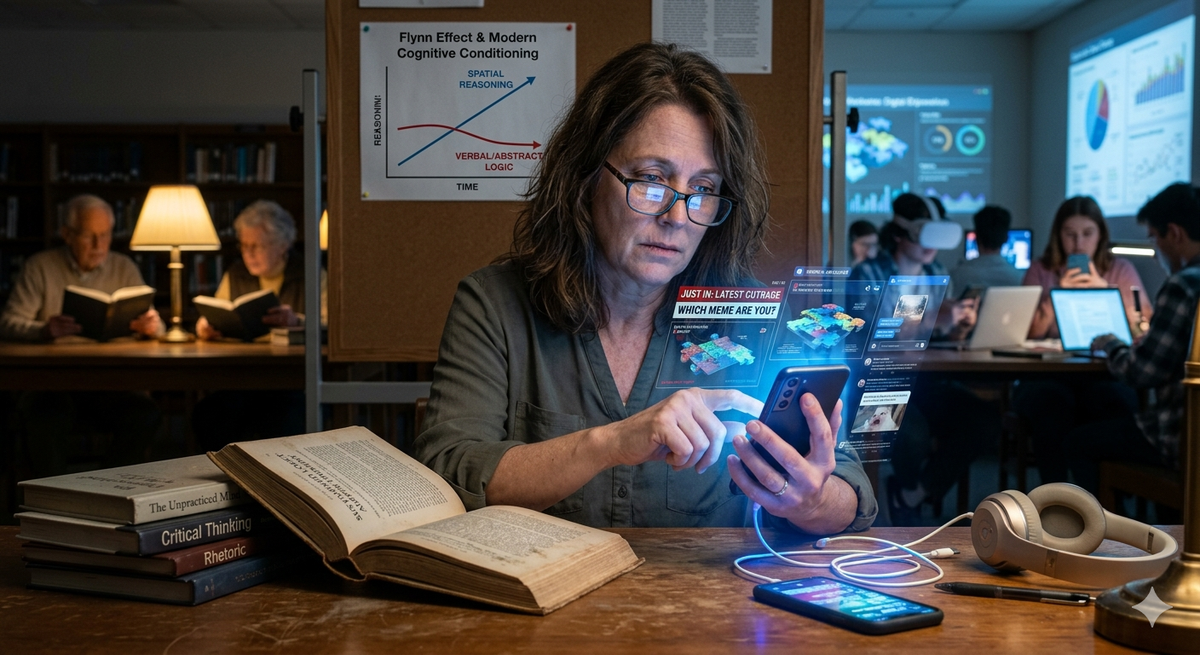
For much of the twentieth century, IQ scores rose across many developed countries. This became known as the Flynn effect. The gains were too fast to be explained by genetic change. Something in the environment was helping people perform better on cognitive tests. More schooling, improved nutrition, more abstract work, more test familiarity, and broader modernization all likely played a role.
That matters because it cuts both ways.
If cognitive test performance can improve because of environment and practice, it can also stagnate or decline when the environment changes again.
Recent research has raised that concern. A 2023 study by Dworak, Revelle, and Condon, published in Intelligence, examined cognitive test data from nearly 400,000 U.S. adults between 2006 and 2018. The researchers found declines in several measured areas, including verbal reasoning, matrix reasoning, and letter and number series. Those are not trivial skills. They involve language, logic, abstract pattern recognition, sequencing, and numerical reasoning.
But the same study also found improvement in three-dimensional rotation.
That detail matters. If everything were falling together, the “people are getting dumber” story would be easier to tell. But that is not what the pattern suggests. Some skills declined while another improved. That points less toward a simple collapse in intelligence and more toward a shift in whatj kinds of thinking modern life trains.
We may be getting better at some visual and spatial tasks because the modern world constantly exercises them. We navigate screens, maps, images, interfaces, videos, games, and visual systems all day. We scan. We swipe. We identify patterns quickly. We move through information-rich visual environments with a fluency previous generations did not need in the same way.
At the same time, many people may be practicing less of the slower work: sustained reading, careful writing, mental math, long argument, abstract reasoning, and patient attention. Those skills do not disappear overnight, but they do weaken gradually when they are not required often enough.
This is the distinction that matters.
Americans may not be losing intelligence in some deep biological sense. Instead we may be losing cognitive conditioning.
That sounds less dramatic, but it may be more important.
A person can have physical strength and still become deconditioned. The muscle is there, but it does not perform well under strain because it has not been used in the right way. Something similar can happen with the mind. Capacity can remain while discipline fades. Ability can exist while practice declines. Intelligence can be present, but unavailable when a situation requires patience, precision, humility, or sustained effort.
That is one reason public life can feel so strange now. We are surrounded by information, yet often starved for judgment. People are not necessarily uninformed. Many are over-informed in the shallow sense. They have headlines, clips, claims, summaries, screenshots, and reactions. They have access to more information than any previous generation could have imagined.
But access is not the same as understanding.
Information does not automatically produce wisdom or automatically create judgment. It does not automatically teach a person how to compare sources, detect weak evidence, follow a long chain of reasoning, hold uncertainty, or change their mind without feeling humiliated.
Those are learned, practiced habits. And like any habit, they can weaken.
This is where the question becomes more serious than insult. The concern is not that Americans are simply stupid. That explanation is too easy and too self-satisfied. The deeper concern is that many of the routines that once trained useful intelligence are less central to daily life.
Deep reading competes with scrolling. Writing competes with posting. Reflection competes with reaction. Memory competes with search. Conversation competes with performance. Education competes with credential completion. Evidence competes with identity.
In that environment, intelligence can become underused or uneven. It can become specialized for fast recognition but weak at slow judgment.
A person can be clever and still careless. Or educated yet still poorly disciplined. A person can be informed and still easily captured by whatever confirms their side.
That is why the better question is not, “Are Americans getting dumber?”
The better question is, “What kinds of thinking are we training, and what kinds are we neglecting?”
That question does not let anyone off the hook. It does not blame biology. It does not romanticize the past. It does not pretend earlier generations were always wise, fair, literate, or rational. They were not. Every age has had superstition, propaganda, conformity, ignorance, and bad arguments.
But our age has its own weakness. We have built a world where the mind is constantly stimulated but not always strengthened. We reward speed more than depth, confidence more than correction, reaction more than reflection. We reward the appearance of knowing more than the discipline of thinking well.
So no, the case is not proven that Americans are simply less intelligent.
The more troubling possibility is that intelligence is still there, but many of the habits that make it useful have weakened. A society can keep its intelligence and still lose its discipline.
And once that happens, unused intelligence can look a lot like decline. But maybe I am just being dumb.
Last week's article: Critical Thinking: A Daily Practice.