The Unpracticed Mind: The Skills We Stopped Rehearsing


Are we less capable, or simply less practiced?
Voice & Vision | The Unpracticed Mind, Part 2 | Cognitive habits
The strongest argument against saying Americans are simply “getting dumber” is that the decline is not even.
Some measured skills have slipped. One, three-dimensional rotation, has improved. That complicates the easy story. A general collapse would look different. It would show weakness across the board. Instead, the pattern suggests something more specific: Americans may be losing ground in verbal reasoning, abstract pattern recognition, and numerical sequencing while gaining strength in visual-spatial tasks.
That does not point neatly to a less intelligent population.
It points to a differently trained one.
Culture rehearses the mind. What daily life repeatedly demands, the mind gets better at doing. What daily life no longer requires with the same force, the mind practices less.
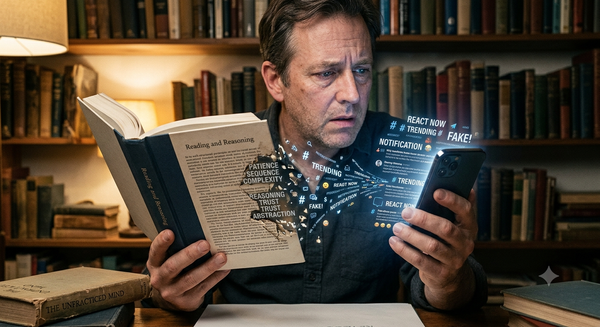
Modern life gives constant practice in visual navigation. We move through icons, dashboards, videos, maps, games, menus, feeds, and screens. Even people who are not especially technical learn to read visual layouts quickly. They know where to tap, how to scan, how to follow a digital path, and how to move through image-heavy environments almost automatically.
That is a real cognitive skill. It should not be dismissed.
But it is not the same as following a dense argument, interpreting a difficult paragraph, handling numbers with confidence, or holding several conditions in mind before reaching a conclusion.
Those skills require a different kind of rehearsal.
Verbal reasoning grows through reading, writing, discussion, and careful listening. It depends on vocabulary, context, implication, and precision. A person who rarely reads complex material may still be intelligent, but that intelligence has fewer chances to practice careful language.
Numerical reasoning works the same way. A calculator can produce an answer, but it cannot give a person number sense. It cannot teach proportion, risk, probability, scale, or the ability to notice when a statistic sounds impressive but means very little. Those skills come from repeated contact with numbers, not just access to tools that process them.
Abstract reasoning also needs use. It asks the mind to look beneath the surface. What pattern connects these examples? What assumption is carrying this argument? What would have to be true for this conclusion to hold?
Those questions are not natural habits in a culture built around speed.
The modern information environment rewards fast recognition. It rewards the quick take, the instant reaction, the familiar side, the clean outrage, the easy dismissal. That does not make people stupid. But it does condition them toward immediacy.
This is where the problem becomes practical. Most adult decisions require more than fast recognition. A medical choice, a financial risk, a political claim, a workplace conflict, or a family crisis often requires patience, language, numbers, context, and uncertainty.
Those are exactly the places where underused skills begin to show.
The danger is not that Americans have lost the capacity to think. The danger is that many people are less practiced at the kinds of thinking that protect them from manipulation, oversimplification, and false certainty.
That is why the improvement in visual-spatial skill matters. It keeps the argument honest. People are not simply declining. They are adapting to what the culture asks them to do most often.
The question is whether the culture is asking enough of the right things.
A society that constantly trains people to move through images may produce people who are visually fluent. A society that rewards fragments may produce people who are quick with fragments. A society that rewards reaction may produce people who feel informed because they are always responding to something.
But if that same society gives less time to reading, writing, reasoning, calculating, listening, and revising, it should not be surprised when those abilities weaken.
This is not nostalgia. Earlier generations were not automatically wiser or more rational. They had their own myths, prejudices, and failures. But each age trains the mind differently. Ours trains speed better than patience. It trains exposure better than comprehension. It trains confidence better than correction.
That imbalance has consequences.
Unused intelligence can look a lot like declining intelligence.
And the skills we stop rehearsing do not vanish all at once. They fade quietly, until a society finds itself surrounded by information and short on judgment.
Help spread the word and encourage thoughtful discourse. Share on your favorite social media sites. Stay thoughtful and thanks for reading