
Why Everything Feels True Now
What Critical Thinking Actually Is…and Isn’t
Voice & Vision | How We Learned to Stop Thinking, Part 1
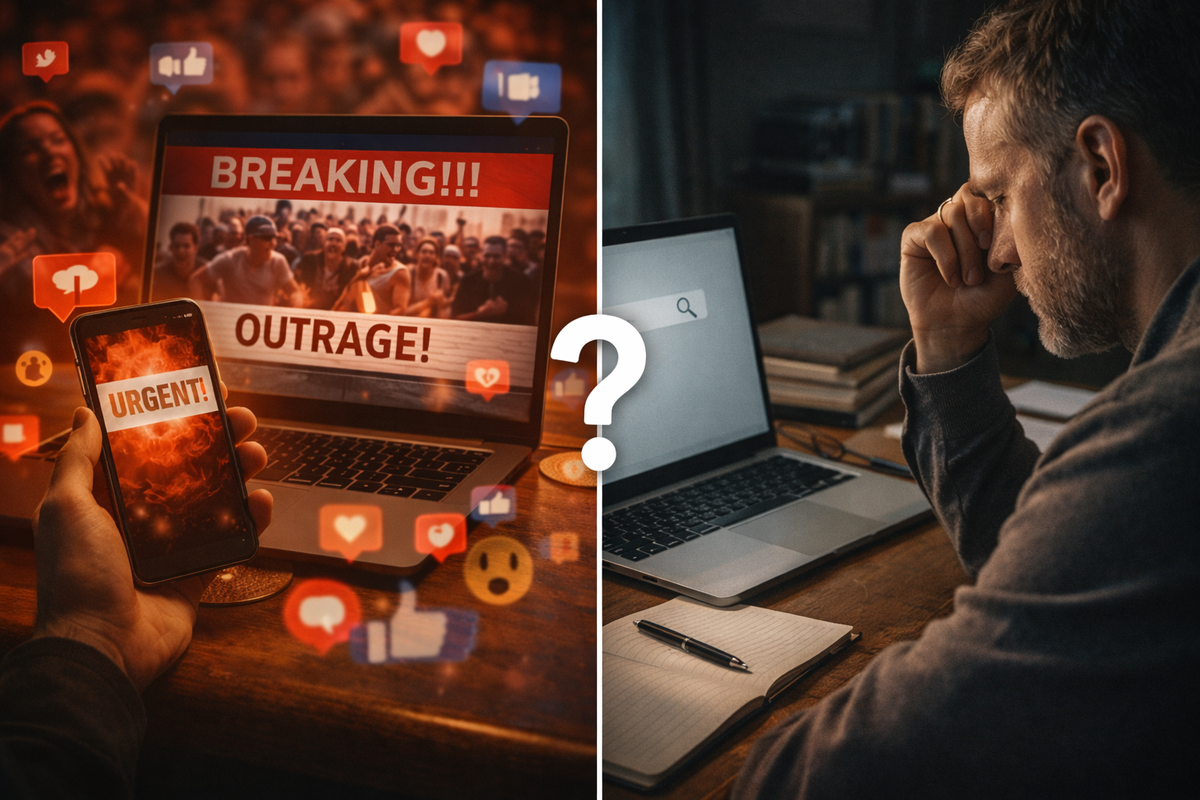
We live in a time where almost everything feels true the instant we see it. Not because it’s well supported or carefully argued, but because it lands with emotional force. The headline hits. The clip outrages. The post confirms what we already suspect. And before we’ve had time to think, we’ve reacted. Shared. Chosen a side.
Algorithms didn’t create this instinct, but they’ve trained it relentlessly. They reward speed over reflection. Emotion over evaluation. Outrage over understanding. The more a piece of content makes us feel something fast, the more it spreads. Over time, we’re trained to adapt. We stop asking whether something makes sense and start asking how strongly it makes us feel.
That’s the environment in which critical thinking is trying to survive.
And it’s why this isn’t a series about being smarter. It’s not about IQ, education level, or knowing more facts than someone else. Most failures of critical thinking aren’t intellectual. They’re emotional. They happen in the split second when feeling replaces restraint.
Critical thinking isn’t skepticism for its own sake. It isn’t cynicism, contrarianism, or distrusting everything by default. It isn’t Googling harder or collecting facts like trophies.
At its core, critical thinking is the discipline of slowing down when emotions spike.
It’s the ability to pause and ask a very simple question before reacting: does this actually make sense?
That question alone filters out a surprising amount of nonsense. Does this claim sound plausible in the real world? Does it rely on a simple villain and a clean moral story? Is it framed to make you angry, afraid, or self-righteous before you’ve had time to think?
Emotional manipulation isn’t subtle anymore. When a message is designed to bypass reasoning and go straight for the gut, that isn’t persuasion. It’s a huge red flag.
Our brains are wired to prefer simple stories with clear heroes and enemies. It’s efficient. It feels safe. Complex explanations require effort, uncertainty, and patience. Outrage feels like awareness. Confidence feels like knowledge. But neither guarantees understanding. The louder and more certain a claim sounds, the more careful we should be, not less.
Critical thinking often begins with another overlooked question: can this even be researched?
Some claims can be checked. Others are framed so vaguely or emotionally that no amount of searching will ever resolve them. Learning to recognize the difference matters. Not everything that feels important is structured in a way that allows truth to be tested.
So if there’s a reset this series aims to offer, it’s this:
Critical thinking doesn’t start with intelligence. It starts with restraint.
With the ability to sit with discomfort for a moment and ask whether something makes sense before deciding what it means. In a culture trained to react first and think later (if at all) that pause has become a quiet act of resistance.
And it’s where thinking actually begins.
Continue with part 2: How We Learned To Stop Thinking.