Built by Hand

America became powerful by making real things, including lives that made sense.
Voice & Vision | The Last Shift Series, Part 2 | Manufacturing, dignity, and the middle class
In Part 1: The Last Shift, we stood at the factory gate and watched the lights dim. Automation turned a hundred jobs into ten, one, or maybe none. Human labor faded, not because people stopped needing products, but because the way they were produced changed.
This part steps back to answer a simple question.
What did American manufacturing build, really?
The obvious answer is cars, steel, ships, appliances, aircraft, roads, and neighborhoods. The deeper answer is that manufacturing built the American middle class by tying skill and reliability to stability. It also built belief, the belief that if you learned a skill, showed up, and did the job well, you could build a life that made sense.
America did not become dominant by managing spreadsheets. It became dominant by making things at scale, with skill, and by rewarding the people skilled enough to keep the system running.
For much of the twentieth century, the economy was powered by workshops large and small. Innovation was physical. It lived in tooling, tolerances, and the quiet knowledge of the people closest to the work.
The power was never just the product. It was the ecosystem. A plant supported suppliers, schools, diners, and a downtown that stayed alive because paychecks kept coming.
When we say manufacturing built America, that is not nostalgia. It is a description of the structure that created one of the broadest middle classes in modern history.
The bargain that made stability possible
The manufacturing era offered a clear bargain. If you brought dependability and skill, the economy offered stability. Wages that could support a household. Benefits that meant an injury or illness did not automatically become ruin. Pensions that made old age less fearful.
That bargain held for a reason. When a country is building at scale, labor matters. When labor matters, workers have leverage. Unions became part of that story not because unions were flawless, but because bargaining power is what turns effort into security.
There was also a cultural component that is easy to miss today. Work was not only a transaction, it was a role. You were not only employed, you were useful. You were part of something visible.
Skill and craft were leverage
In the manufacturing era, skilled trades were not a consolation prize. They were core. Machinists, welders, electricians, mechanics, and toolmakers kept America running.
A skilled worker has leverage because skill is hard to replace and slow to build. Skill also creates quality and safety. That is why it was worth investing in, and why apprenticeships mattered. They were pipelines of capability, a way knowledge moved from one set of hands to the next. Someone trusted you with real work, then taught you how to do it right.
Let me put it in a scene.
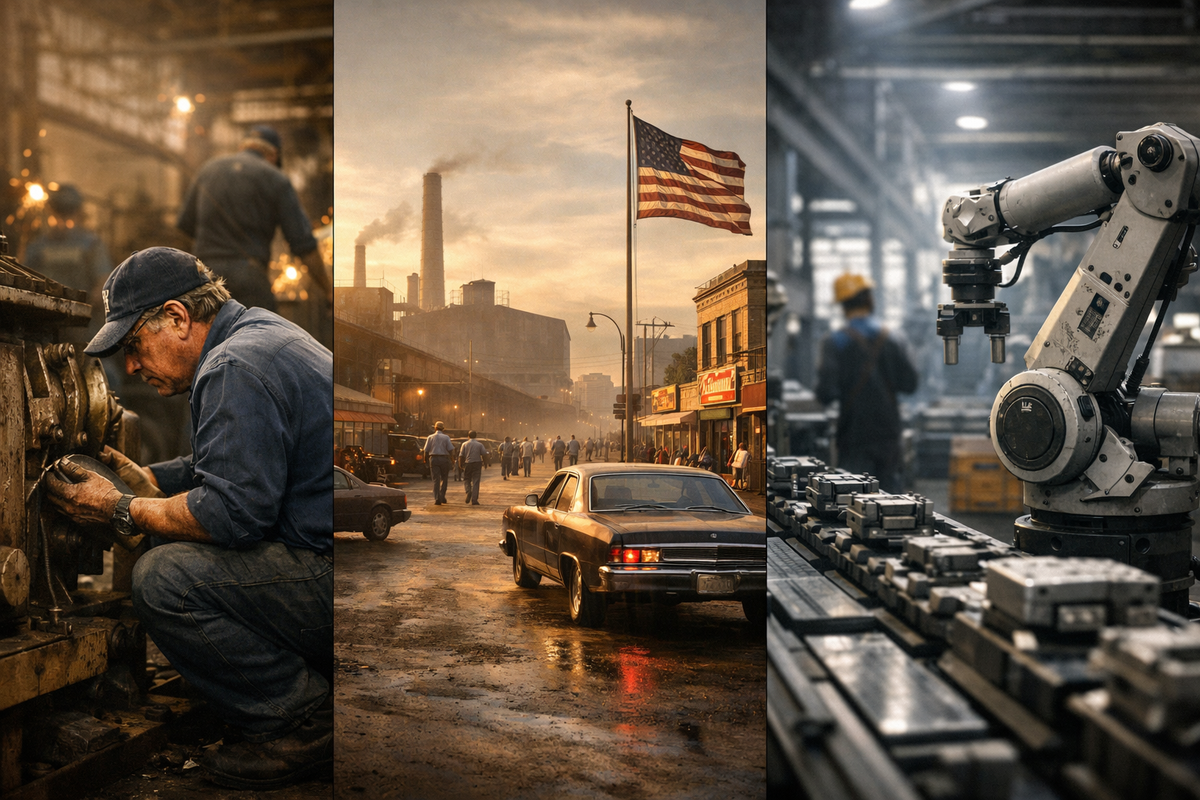
It’s 1978. A machine is down. The line is waiting. The clock is still running. Someone crouches beside the equipment, listening, feeling vibration through the frame, reading the machine the way a good mechanic reads an engine. The problem is not on a screen. It is physical, a bearing, a belt, a misalignment. Tools come out. Hands get dirty. The fix happens. The machine starts. The line moves.
People nod, not out of sentiment, but because competence just saved the day.
That moment is not just a work story. It is the feeling of being needed, trusted, and competent in a way the world can see. That is what many people mean when they say they want dignity. They mean usefulness, respect, and stability, all at once.
Manufacturing spread prosperity outward
Making things tends to spread money across a community. Plants need suppliers. Suppliers need truckers. Truckers need mechanics. It is an ecosystem that creates many solid jobs, not just a few elite ones.
When a country shifts away from manufacturing, wealth tends to concentrate. It moves upward into ownership, finance, and decision layers that can be far from the town that loses the plant.
Keep the history honest
None of this should be polished into a fairy tale. The manufacturing era was dangerous. It was also often discriminatory. Many people were excluded from the best jobs and the strongest protections. Bodies bore the brunt and were used up early.
Acknowledging that does not weaken the point. It strengthens it. The point is not that the past was perfect. The point is that the structure of making, combined with bargaining power and training pipelines, created a wide base of stability that a country can stand on.
When that base erodes, everything above it begins to crack.
When “where” stopped mattering
Somewhere along the way, the question quietly changed. It was no longer “How do we keep making this here, well?” It became “Where can we make this, for less?” Manufacturing did not become optional. Domestic manufacturing became conditional, and production moved wherever cost and convenience pointed.
The logic sounded clean. If you can produce somewhere else for less, why not? If a machine can do it cheaper and faster, why keep the human? If investors demand higher returns, why not squeeze labor like any other cost?
This is the hinge. Offshoring and financial pressure weakened the old bargain. Automation then accelerated the break. The worker began to look like a cost instead of a contributor. Productivity charts replaced judgment. Quarterly reports replaced long-term commitment. The factory became a financial asset first, and a community anchor second, if at all.
That shift is bigger than economics. It changes the meaning of work, and often the meaning of someone’s life. It is the transition from maker to manager, from craft to metric, from building to optimizing.
What we lost, and what comes next
Manufacturing built twentieth-century America with a large, confident middle class. That middle class did not just earn money, it earned a place. A role in the country’s story. There was prestige in building America, practical prestige.
Today that prestige is fading because the structure that produced it is fading. Not only the jobs, but the ecosystem and the bargain that made those jobs a path to a stable life.
The human manufacturing era is coming to an end. Even when factories return, they return smaller, quieter, and more automated. The next version of making will involve software, robotics, AI systems, and forms of production we have not even named yet.
But the country still has to answer the same core question: what do we owe, and do with, the people whose identity and dignity were built around making real things?
Part 3 makes the case that this was not only economic change. The harder damage is cultural. When effort no longer leads to stability, trust weakens. And a nation that cannot maintain trust will eventually pay a price that no spreadsheet can capture.