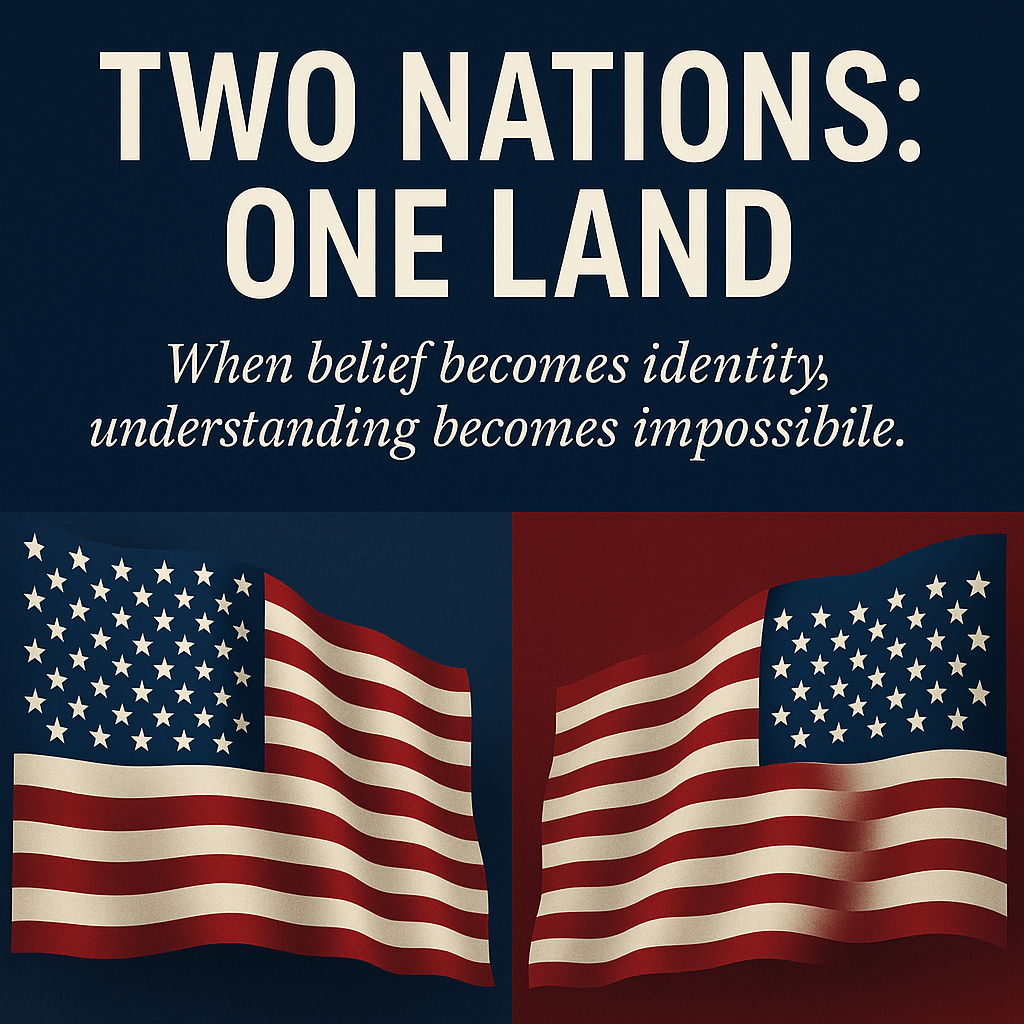
Two Nations: One Land
When belief becomes identity, understanding becomes impossible
VOICE & VISION | The Divided States of America, Part 1
By TLS
This is the first of a five- part, but possibly continuous, series. The purpose? To do my part to help us remain the United States of America. Fingers crossed.
The United States is in serious trouble. Probably not since the Civil War have we been as divided as we are today. But why?
Half the country wants to make America great again. The other half believes we’ve barely reached fair. Both claim to love the same nation. But they’re describing two very different Americas.
We’ve never been this connected and yet this divided at the same time. Our arguments travel at the speed of light, but our understanding hasn’t kept up. Neighbors, coworkers, even families now live inside different versions of the same country. Each side speaks its own language of pride and pain, certain the other can’t understand.
This divide isn’t just political. It’s cultural, educational, moral, informational, and even geographical. It shapes how we see truth, trust authority, and define what being American means. I briefly covered this in an earlier piece Is It Uniting or Dividing.
What follows isn’t about choosing sides. It’s an attempt at understanding how two movements, MAGA and the Pro-Democracy Coalition, came to represent more than parties or platforms. They’ve become competing stories about who we are, who belongs, and what future we deserve.
These aren’t just political differences. They shape how we raise our kids, what we teach in schools, how we talk at work, and even who we trust. The divide has moved from the ballot box into daily life, changing how we live, not just how we vote.
What MAGA Wants
Much of the core of the MAGA movement isn’t just about Donald Trump, and what comes with him. It’s about nostalgia, control, and the feeling of being left behind.
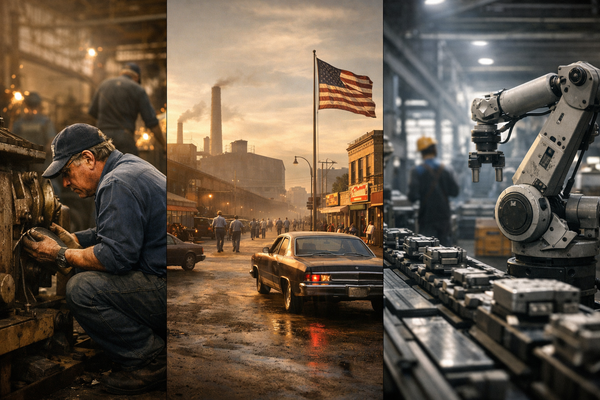
Its followers want borders, strength, and order. They want factories humming again, energy that’s “ours,” and schools that look like the ones they grew up with. They want to stop apologizing for being American.
In their view, “America First” means protecting what’s familiar. They see globalization, diversity, and equality not as progress, but as loss.
They feel elites look down on them, media mocks them, and government ignores them. MAGA promises something simple: to make them matter again.
The MAGA Cultural Undercurrent
However, beneath the slogans and rallies lies something else.
Much of MAGA’s pull comes from a sense of cultural displacement. The America many supporters want to make great again often resembles a version from decades past: more Christian, more uniform, more…white.
That doesn’t mean every supporter is racist. It means the image of the country they’re defending is tied to a time when whiteness, Christianity, and traditional gender roles defined “normal.”
The language of pride, heritage, tradition, and “real America” can sound patriotic. But it also blurs into cultural protectionism, where diversity and inclusion feel like erosion instead of evolution.
Polls consistently show that racial resentment and fear of cultural change are stronger predictors of MAGA allegiance than income or class (Pew Research Center 2023; PRRI 2023). Many sincerely believe that equality for others has come at their expense. That belief fuels grievance, and grievance fuels loyalty.
Nationalism, in that context, becomes more than love of country. It becomes a defense of identity.
What the Pro-Democracy Coalition Believes
The Pro-Democracy Coalition doesn’t always rally behind a single slogan, but it shares a mission.
It believes America’s greatness lies in openness, in a system that protects rights, respects law, and learns from its past. It values inclusion, fairness, and science. It trusts that institutions, though imperfect, can still correct themselves if people stay engaged.
Its members see diversity as strength and isolation as decay. They look outward, not backward, believing progress depends on dialogue, education, and civic participation.
To them, “make America great” means making it just, not returning to what was, but continuing what was started.
The Pro-Democracy Mirror Undercurrent
But, beneath that confidence runs its own layers, just as powerful and just as human.
The Pro-Democracy Coalition often sees itself as enlightened, educated, and morally on the right side of history. It believes the arc of the moral universe is bending toward justice and that it’s helping bend it.
That conviction gives purpose, but it can also harden into moral arrogance, the belief that dissent equals ignorance or bigotry.
For some, politics becomes a kind of virtue test. Where MAGA takes pride in heritage, the Pro-Democracy side takes pride in awareness. And that pride, too, can become identity.
The same institutions MAGA distrusts, media, universities, and corporations, are the ones this coalition often occupies or influences. That can create a sense of cultural elitism, where rural or religious America feel dismissed as outdated or uneducated.
At its best, this worldview expands empathy. At its worst, it enforces it, through social shaming, moral policing, and a quiet belief that some voices no longer deserve to be heard.
If MAGA clings to an imagined past, the Pro-Democracy Coalition sometimes reaches for an imagined future, one where all people finally understand. Both fears are real: the fear of being replaced, and the fear of moving backward.
The Education Divide
Beneath these cultural differences lie other fractures, quieter but just as deep. Within both movements runs one of the deepest divides in modern America: education.
The MAGA base is built largely from non-college voters, people whose skills and pride were forged in work, faith, and community rather than classrooms. The Pro-Democracy Coalition leans toward the college-educated people, shaped by institutions, credentials, and networks that reward abstraction over hands-on experience (Brookings 2024; FiveThirtyEight 2024).
One side trusts its gut; the other trusts its data. One learns through life; the other through lectures. Both believe they see the world clearly.
But, this divide isn’t just about degrees; it’s about status and respect. Those without degrees feel dismissed by those who have them. Those with degrees feel exhausted trying to reason with those who distrust expertise.
Surveys show that trust in media, science, and universities has collapsed among conservatives while remaining high among liberals (Gallup 2023). It’s not ignorance on one side or arrogance on the other; it’s a clash of realities.
Until each can respect the other’s version of wisdom, our politics will keep sounding like two different languages spoken at the same table.
The Geography of Discontent
There’s also a regional divide. MAGA draws strength from small towns, rural regions, and forgotten industrial cities, places that once thrived on making things. The Pro-Democracy Coalition thrives in urban and suburban centers where education, tech, and service economies dominate (Brookings 2024).
Rural America feels unseen, its labor and values turned into punchlines. Urban America feels overburdened, paying more taxes and blamed for everything wrong. Each sees itself as the backbone of the country. Each believes the other doesn’t understand real life.
The divide isn’t only about geography; it’s about belonging. One America feels left out, the other feels trapped.
The Information Divide
Beyond geography lies a deeper split, not just what people think, but where their truth comes from. I addressed this in an exasperated piece Water is Wet & Sky is Blue.
MAGA’s information world is horizontal, built on talk radio, podcasts, and peer networks that reward distrust of institutions. The Pro-Democracy world is vertical, built on journalism, science, and academic consensus that depend on public trust (Pew Research Center 2024).
One side says, “They lie to control you.” The other says, “They believe lies because they won’t read.”
It’s not disagreement; it’s a fracture in reality. Two separate information ecosystems now produce different facts, feeding two separate versions of the same nation.
The result isn’t just polarization; it’s isolation. Each side sees the other’s world as propaganda and their own as truth. And when no one agrees on what’s real, compromise becomes near impossible.
The Great American Mirror
At their core, both movements are reacting to fear. MAGA fears a world that’s changing too fast. The Pro-Democracy Coalition fears a country refusing to change at all. Each believes it’s saving America from destruction and sees the other as the threat. But maybe they’re not opposites. Maybe they’re reflections, different answers to the same question: what kind of country do we want to be, and who gets to decide?
A Hard Truth
Both views are understandable, the desire to preserve and the need to progress. One side wants to protect what it loves; the other wants to fix what it sees as broken. Both, in their own way, are fighting for belonging.
The problem isn’t disagreement; it’s the loss of a shared purpose. We no longer argue about how to build the country, but about who it should belong to. That shift has turned politics into identity and identity into warfare. The Founders built a system designed for tension, but not contempt. It can survive conflict; it cannot survive loss of belief in the idea of a common good.
I think about that a lot. How far have we drifted from belief in the common good? How close are we to all out conflict?
That common good may still be possible though, if we have the courage to work for it. But courage isn’t simply the absence of fear; it’s choosing trust when you want to distrust. The nation we say we want, fair, strong, and free, can’t be built by people who see half their neighbors as enemies. Democracy isn’t something we inherit; it’s something we practice, as I wrote in Call to Action! Democracy Not Destruction! and practice takes patience, restraint, and grace.
Maybe what we’ve really lost isn’t our values or our borders. Maybe we’ve lost humility, the kind that makes compromise possible and democracy real. America’s real fight isn’t left versus right. It’s fear versus trust. And whichever one wins will define what kind of country we become next.
We don’t have to agree on everything to rebuild trust. We only have to agree that remaining together is better than losing each other. Democracy is fragile, it requires people to believe and to have faith in each other. Maybe that’s where rebuilding begins, not in winning, but in remembering who we are in the first place, we are Americans.
Next week, VOICE & VISION | The Divided States of America, Part 2