Moscow’s Mission: Priming the Fuse on America’s Powder Keg
Part 1: The Mission
Voice & Vision | Moscow’s Mission, Part 1
TLS
This was not noise. It was a plan.
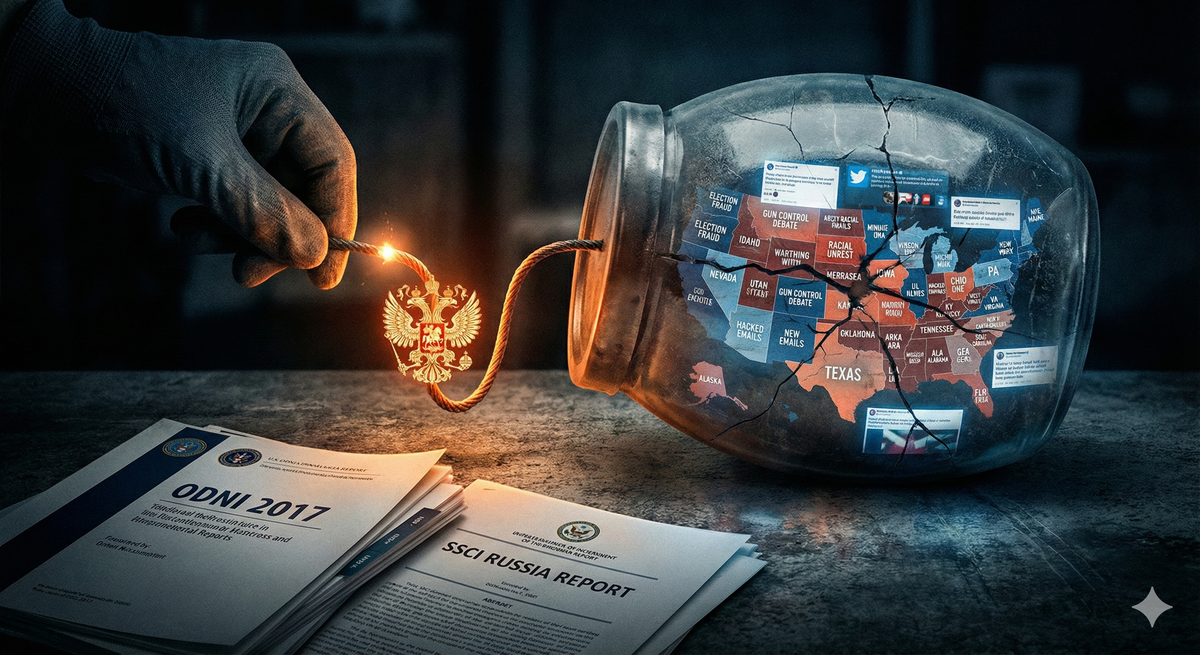
Russia set out to do three things at once. Erode trust in U.S. institutions, shape the news agenda around division, and damage specific candidates when useful. That statement is not my personal hunch or rabbit hole conspiracy. It’s the consensus of U.S. intelligence and years of bipartisan investigation. (ODNI 2017; SSCI Russia Report; Mueller Report)
Most Americans do not know this, or at best give it a mild shoulder shrug. Russia has done significant, possibly irreparable and fatal damage to this country; and most Americans barely even notice…or care.
The campaign had two main lines of effort. The first was social influence at scale. Russian operators posing as Americans built pages and personas that blended into the feed, then pushed race, immigration, gun rights, religion, and veteran identity until comment threads turned into bonfires. The second was “hack and leak.” Military intelligence units stole emails and documents, then dripped them into U.S. media ecosystems to maximize political damage and sow doubt about what to trust. These were not isolated random stunts. They were synchronized with intention. (Mueller Report; DOJ 2018 GRU Indictment; SSCI Russia Report)
Why was the United States such a ripe target in 2016 and after? High social media use, weak platform guardrails, and a fractured media market created a perfect operating environment. There was no need for a massive army of trolls. All that was needed was believable characters and content that looked like us. Once the posts entered American networks, Americans did most of the amplifying, and damage. That pattern is documented in the Senate Intelligence Committee’s social media report and in later election assessments. (SSCI Russia Report; ODNI 2021; Oxford Internet Institute 2018)
Here's the through line the official reports make clear. Russia ran a “multifaceted” influence campaign designed to undermine faith in the democratic process and to shape public preferences where it could. That is the Intelligence Community’s 2017 bottom line about 2016. The 2021 assessment on the 2020 cycle says the same story continued in updated form. The target was trust, the weapon was us. (ODNI 2017; ODNI 2021)
If you look under the hood, you’ll see how the two lines of effort fed each other. Social personas created the climate. Hack and leak supplied the accelerant. When stolen materials dropped, the same networks that had been primed by divisive content were ready to push them far and fast. The Senate report ties those pieces together explicitly, noting the Russian military’s role in acquiring and spreading hacked files while the Russian Internet Research Agency (IRA) worked the social side. Different arms. Same objective. (SSCI Russia Report; Mueller Report)
The goal was not only who won or lost. It was whether Americans would believe results, trust each other, or accept basic facts the day after. Intelligence assessments and later briefings emphasize this point. Interference isn’t only about vote totals. It’s about the operating system of a democracy. If you can make citizens doubt the count, doubt the courts, doubt the press, and doubt one another, you can make the country ungovernable without firing a shot. (ODNI 2021)
We also learned something uncomfortable about our own information habits. The most effective Russian content didn’t invent new arguments. It mirrored our grievances back to us, just a little louder and a little meaner. The Senate committee’s findings describe how operators targeted communities that already felt ignored or inflamed, then pushed them further along lines of identity and ideology. It worked because it felt local. It worked because it felt like us. (SSCI Russia Report; Oxford Internet Institute 2018)
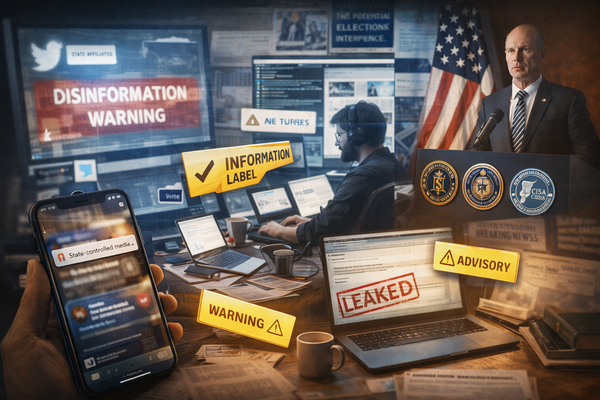
So what changed after 2016? The playbook evolved, not the mission. Platforms added labels, archives, and takedowns. Government issued warnings. Journalists built verification desks. Yet the 2021 intelligence assessment still found ongoing foreign influence efforts aimed at the same fault lines. Less overt hacking in some cases, more tailored amplification in others. The defenders added patches. The boat still leaked, profusely, because the cracks are still there. (ODNI 2021; FBI–ODNI–CISA 2020)
Two ideas are worth holding as we go deeper in this series.
First, scale is misleading. A small, disciplined influence team can shape a much larger conversation if it rides our own networks well. Think of it as guided judo, not brute force. The Senate report’s timeline shows how fast tailored posts could spark real American engagement, events, and media coverage. Once it looks organic, it is. (SSCI Russia Report; Oxford Internet Institute 2018)
Second, attribution does not undo impact. Even when platforms or agencies identify a foreign hand, the content has already done its work. Screenshots live on. Arguments migrate to native accounts. Narratives become “what everyone is saying,” with or without the original source. That durability is why the goal is trust, not just turnout. Intelligence assessments stress that point across cycles. (ODNI 2021; Meta Takedowns Archive)
This is the mission as the record shows it. A foreign state studied our fractures, then pressed on them with two tools that modern life makes cheap. Social manipulation at feed speed. Stolen material shaped for maximum heat. The results were not a single race flipped by a single post. The results were a country that woke up arguing over what is real.
Next in Part 2, Voice & Vision | Moscow’s Mission, Part 2 we open the factory floor. Who the personas were. How they sounded. Where they aimed. And how a handful of pages turned division into an export.
If this helped you see the pattern behind the headlines, share it with one person who still thinks this was all background noise. That’s how we rebuild a little trust, one careful reader at a time.
Previous piece on Multiple Views and…News? E Pluribus Unum.
Sources cited
• ODNI 2017 — Assessing Russian Activities and Intentions in Recent U.S. Elections (Intelligence Community Assessment, Jan 2017).
• Mueller Report — Report on the Investigation into Russian Interference in the 2016 Presidential Election (U.S. Department of Justice, Mar 2019).
• DOJ 2018 GRU Indictment — United States v. Netyksho et al. (GRU officers indicted for hacking, July 2018).
• SSCI Russia Report — Report of the Senate Select Committee on Intelligence on Russian Active Measures Campaigns and Interference in the 2016 U.S. Election (multi-volume, 2019–2020).
• Oxford Internet Institute 2018 — The IRA, Social Media and Political Polarization in the United States, 2012–2018 (Howard et al., 2018) and related OII/Graphika studies.
• ODNI 2021 — Foreign Threats to the 2020 U.S. Federal Elections (Intelligence Community Assessment, Mar 2021).
• FBI–ODNI–CISA 2020 — Joint public statements and advisories on ongoing foreign influence activity and fabricated media.
• Meta Takedowns Archive — Platform disclosures documenting removals for coordinated inauthentic behavior, 2018–2021.