
Homelessness Is a Layered Problem

Why it grows even when everyone agrees it should not
Voice & Vision | Homelessness and the Public Commons, Part 1 | The framework
Homelessness is one of those issues that turns adults into warring tribes fast. Someone says housing, another says drugs, someone else says mental illness, yet others say crime, or rights, or compassion, and within ten minutes the room is no longer talking about a real problem. It’s talking about identity.
That’s a mistake, and it’s one we keep paying for.
Homelessness is not one problem. It’s a layered system. That can sound like policy language, but it’s the simplest way to describe what’s happening in real life. There are structural pressures that push people out of housing. Personal vulnerabilities that make it hard to climb back in. There are public-space impacts that turn sympathy into anger and politics into enforcement. Governance failures that keep agencies from pulling in the same direction. There are service bottlenecks that leave people waiting on sidewalks for help that exists on paper. And there are rights and legitimacy constraints that define what a community can do without becoming something ugly. Ignore any layer, and the system finds the gap and grows.
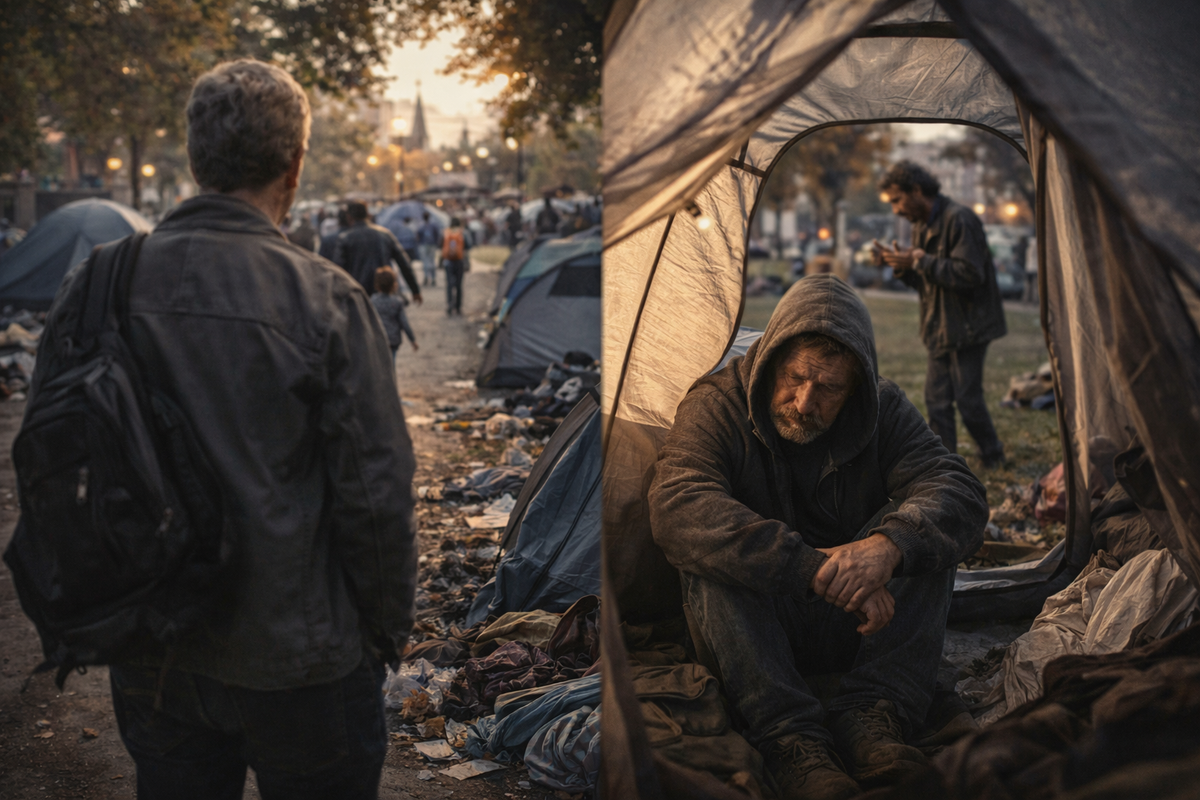
I’d like to start with what this looks like in the wild, not in the abstract. It’s a weekday morning. A commuter walks past the same park they’ve walked past for years. They are not looking for a fight and they are not trying to make a statement. They’re trying to get to work. But now the park has tents along the fence. The benches are stacked with bags. The corners smell like an old bathroom because someone had no other place to go. A man paces, talking to someone who isn’t there. A parent pulls their kid a little closer. Someone steps off the path to avoid something on the ground they don’t want to identify too closely.
That commuter feels two emotions at the same time. Sympathy and anger. Sympathy because it’s obviously human suffering. Anger because the public commons is being used as the default solution, and no one seems to be in charge. Now shift the camera. It’s the same park, but you’re sitting in one of those tents. You’re not there because you read a philosophy paper and decided nomad life was the next chapter. You’re there because last year hit like a wrecking ball. Rent went up, hours got cut, a relationship cracked. A health issue turned into a money issue. A drinking habit went from social to survival. Then you lost your ID, you missed an appointment, and you couldn’t keep a phone charged. Every system asked you to be stable first, and you stopped believing any of them were real.
That is homelessness. A private collapse that becomes public. This is why the argument never ends. People are not reacting to the same experience.
Some people see a human being in distress and feel a moral obligation. Others see a public-space breakdown and feel a civic obligation. Both are valid. The trouble starts when either side pretends the other is wrong. There are strong reasons to help. Homelessness is suffering exposed, and a society that learns to step around suffering without responding hardens itself into something less than ideal. It also becomes expensive and dangerous in predictable ways. ERs get overloaded with preventable crises. Ambulances run to the same corners. Police and courts get dragged into problems they cannot solve. Neighborhoods change in ways residents didn’t vote for and don’t know how to reverse. These costs don’t stay on the street. They spread through the whole city. There are also strong reasons people resist helping, or at least resist the way help has been delivered. They are tired of disorder being treated as normal. Tired of being told they must accept unsafe conditions in parks and business corridors as the price of compassion. They don’t trust government promises because for years they’ve watched money get spent without visible results. They fear that any new shelter, service center, or supportive housing project will concentrate impacts in their neighborhood while everyone else stays clean and congratulates themselves.
None of that is automatically cruelty. Much of it is a demand for boundaries and competence. This series is built around a simple goal. Stop arguing about which single factor is the real cause, and start building a response that matches the layers.
Here’s how we’ll do it.
Part 2 builds the structural engine. Housing affordability, income instability, and weak prevention pipelines are the main reason homelessness grows at scale. If the pipeline never slows, you can clear tents forever and never reduce homelessness.
Part 3 is vulnerability. Mental illness, addiction, trauma, disability, domestic violence, and aging are accelerants. They make homelessness longer, harder, and more visible. Ignore vulnerability, and you build systems that only work for people who are already stable.
Part 4 address the public commons. This is the layer that drives politics, because it’s what residents experience daily. If you surrender public space, backlash becomes inevitable. If you restore it through punishment without exits, you create churn and cruelty.
Part 5 is governance and fragmentation. This is where good intentions die. Multiple agencies, multiple jurisdictions, different incentives, and no shared accountability creates a machine that produces failure.
Part 6 deals with service delivery. This is the pipeline problem, where help exists on paper but breaks down on the street because capacity is short and workflows assume stability.
Part 7 rights and legitimacy. It’s the boundary layer. What can be enforced, what is humane, what is lawful, and what happens when a society mistakes abandonment for compassion.
Part 8 focuses on synthesis. A both-and approach that can actually hold, because it respects both realities: people need help and the commons needs boundaries.
If this sounds like a lot, that’s the point. Homelessness became a permanent crisis in part because we kept trying to solve a complex system with single-lever fixes. We kept choosing either compassion without management or enforcement without exits, then acted surprised when both produced churn.
The goal here isn’t to win an argument, that’s not going to happen. It’s to build a response that reduces homelessness and restores trust, because trust is what collapses when the commons over flow.
That was Part 1. Next, we’ll go to the root of the pipeline problem. See you next week in Part 2 The Housing Pressure Cooker.