Do Your Own Research
Why “Do Your Own Research” became the rallying cry of the marginally literate
Voice & Vision | The Age of Misguided Confidence
By TLS
“Do your own research.”
It sounds noble. Independent. Brave. The call of a free thinker who refuses to be told what to believe. It also happens to be one of the most dangerous phrases of our time.
Because most people don’t actually mean “research.” They mean “Google.”
The Myth of the Enlightened Researcher
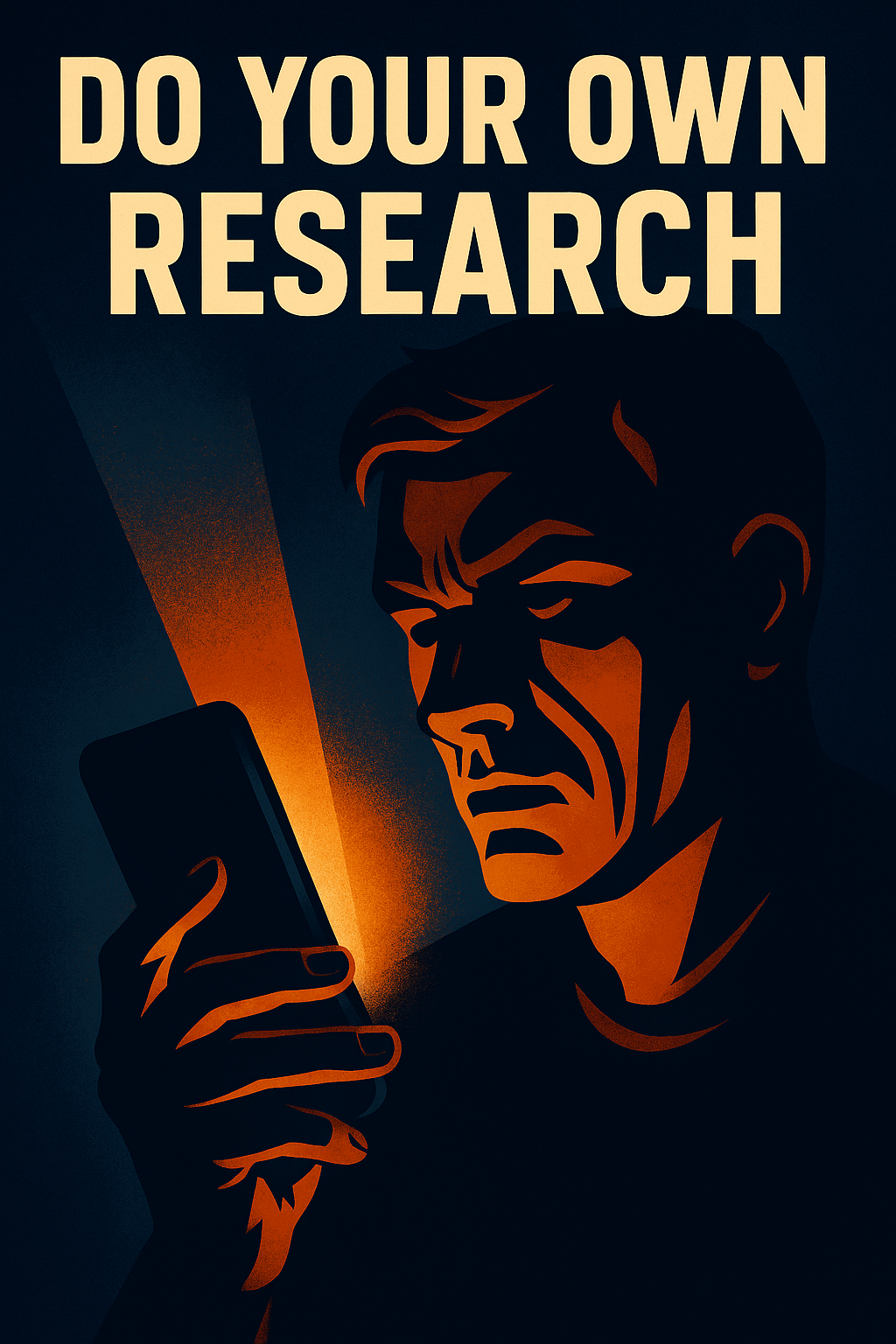
In theory, doing your own research should lead to discovery. In practice, it usually leads to confirmation bias. We start with an opinion, then search until we find someone who agrees with it. That’s not research, it’s self-validation with screen lighting.
The internet’s turned everyone into self-declared experts. One scroll through social media and you’ll find people arguing with epidemiologists, economists, and astrophysicists as if credentials were optional.
And why not? According to the National Center for Education Statistics, about 21% of U.S. adults read at or below basic literacy levels, and another 54% read below a sixth-grade level. That means over half of Americans are ill-equipped to evaluate or conduct meaningful research.
A few charts, a buzzword or two, a confident tone, and suddenly the person who barely passed science in high school believes they’ve outsmarted NASA.
The Idiocracy Effect
Once, we admired people who spent their lives mastering something. We called them scholars, scientists, doctors, or engineers. Now we call them “biased.”
The phrase “Do your own research” has become a permission slip for ignorance. It’s the rallying cry of people who want the authority of experts without the burden of understanding.
Real research takes years. It involves failure, peer review, replication, and humility. It means being proven wrong, often. But in the age of instant certainty, being wrong is intolerable. So we skip the process and cling to our opinions.
We’ve discredited the hierarchy of knowledge until everyone believes their opinion deserves equal weight. The virologist with decades of study and the influencer with a secret decoder ring now share the same stage. One cites data, the other cites a meme, and the audience decides which “feels” true.
Crowdsourced studies show this illusion clearly. When ordinary users were asked to judge truth claims online, accuracy varied widely by training and background, proving the gap between amateur and expert judgment is still massive.
The Algorithm of Gluttony
The more we click what we agree with, the more the algorithm feeds us what we agree with. We build echo chambers and call them libraries. People now confuse exposure with expertise. “I’ve read twenty posts about this” becomes indistinguishable from “I understand it.”
Research confirms the trap. A 2020 study found that users exposed to engagement metrics were more likely to believe false claims than accurate ones, showing how confidence grows while comprehension shrinks.
But the real danger isn’t just misinformation; it’s the psychology of consumption. The algorithm doesn’t sell truth, it sells attention. It learns what you fear, what you envy, what you crave, and then feeds you more of it. Over time, it shapes not only what you believe but what you can imagine believing.
It’s the same reward system that drives addiction, dopamine for discovery, serotonin for validation. Each new click delivers a small sense of mastery, the illusion that we’re “learning” something. But what we’re really learning is how to stay stimulated, not how to think.
This is intellectual gluttony: consuming information without digestion. We gorge on content until we mistake fullness for understanding. The result is a society stuffed with opinions and starved for insight.
Algorithms don’t need to control you directly. They only need to keep you scrolling. They whisper, “You’re right. You already know enough.” And when enough people believe that, democracy itself becomes ungovernable.
The Internet rewards certainty, not accuracy. The louder and more confident a claim sounds, the faster it spreads.
That’s not research. It’s good marketing.
The Hard Part: Admitting We Don’t Know
Real research begins where our confidence ends. It asks questions instead of making declarations. It demands curiosity, patience, and a willingness to be corrected. Those aren’t popular traits anymore. But they’re essential if we want truth to mean anything.
Admitting we don’t know feels uncomfortable because it threatens identity. We’ve built our social selves around being “informed.” To say “I don’t know” risks exile from our tribe. Online, uncertainty reads as weakness. But in science, in journalism, in life, it’s the starting point of wisdom.
The humility to say “I might be wrong” is what separates education from indoctrination. It’s also what separates progress from collapse. Every discovery that ever mattered began with someone willing to admit ignorance and follow curiosity.
Today, we do the opposite. We start with conviction and work backward toward evidence. We call that research, but it’s really a defense mechanism. It protects our pride at the expense of our understanding.
To move forward, we’ll have to rebuild our tolerance for uncertainty. We’ll have to stop confusing loudness with knowledge and skepticism with cynicism. Questioning authority is healthy. Questioning reality itself isn’t.
The moment everyone becomes their own expert, expertise stops mattering. And when expertise stops mattering, civilization starts guessing. History shows what happens when civilizations start guessing. They collapse.
Closing Reflection
“Do your own research” was once advice for the curious. It’s now an excuse for the stubborn. If we want truth back, we’ll have to recover something rarer than information: Humility. The kind that says, “I don’t know, but I’ll ask someone who does.”
Real research begins there.
Don’t miss last Wednesday’s post: Fear vs Trust: The Real Fight.
Or Sundays’s post: The Joy of Coffee: Why Espresso, Aroma, and Ritual Matter
Data Sources
National Center for Education Statistics (NCES), PIAAC Literacy Survey, 2019
National University, Adult Literacy Statistics and Facts, 2023
Stanford Graduate School of Education, Evaluating Online Information, 2020
Harvard Kennedy School, Digital Literacy and Misinformation Review, 2022
USC, Why Fake News Spreads on Social Media, 2023
arXiv, Engagement Metrics and Misinformation, 2020; Crowd Judgments of Misinformation, 2021